In Fort Worth, it depends entirely on what you touch. The city does not require a permit for cosmetic work such as flooring, wall coverings, cabinets, countertops, and shelving, or for swapping a plumbing fixture in kind. You do need permits the moment the job involves structural changes, new or relocated electrical, moved plumbing or gas lines, or mechanical and ventilation work. Most full kitchen remodels cross that line, because moving a sink or adding circuits for a new layout is exactly the kind of work permits exist to cover.
This is the question homeowners ask us most often, and the honest answer has two halves: a clear rule from the City of Fort Worth, and a set of judgment calls about where your specific project falls. Below is the line the city actually draws, which permits a kitchen typically needs, what they cost, how long review takes, the inspections you will go through, how the rules differ in Arlington, Southlake, Grapevine, and the other cities we work in, and what skipping the paperwork really costs you when you sell.
What does not require a permit in Fort Worth
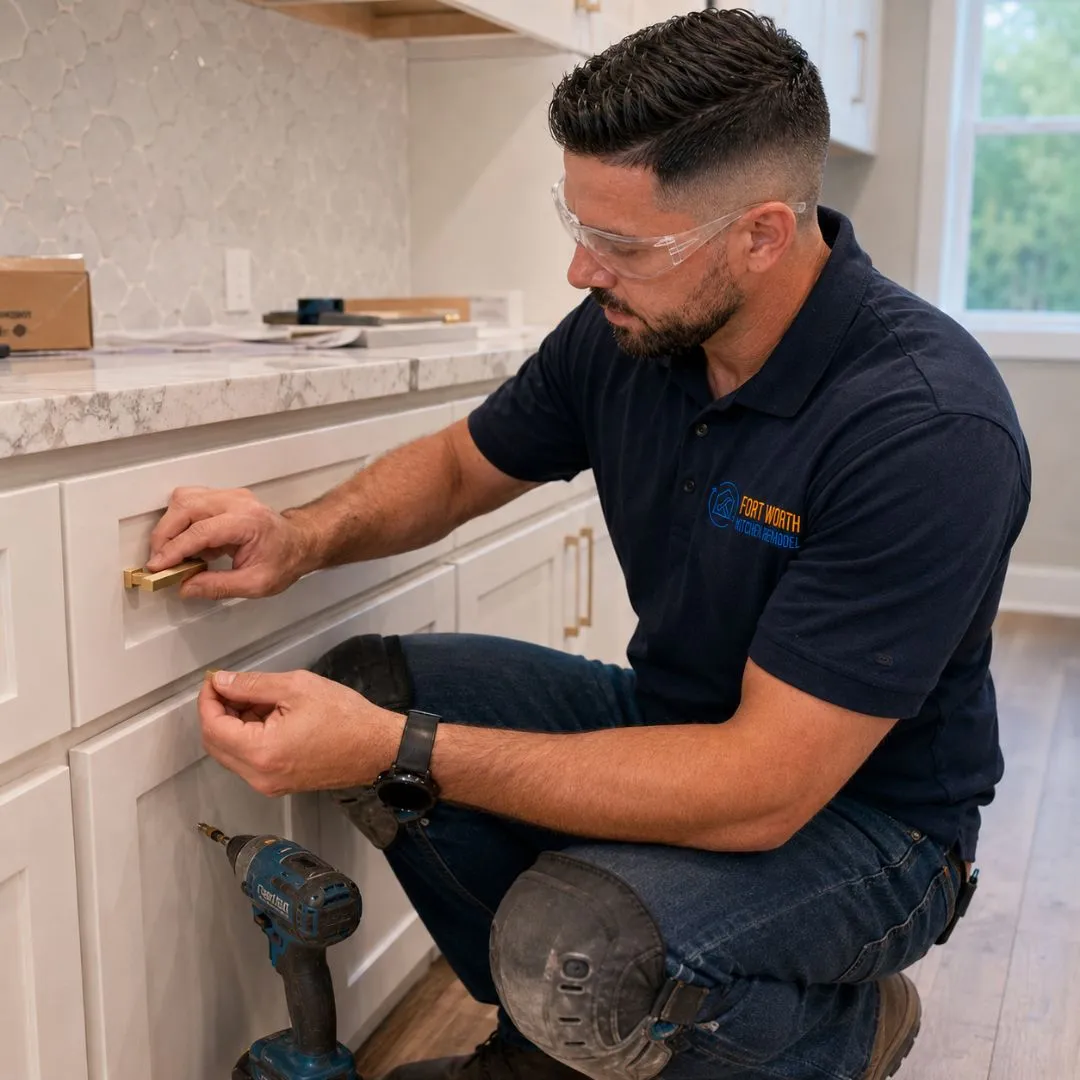
Fort Worth Development Services exempts cosmetic remodeling. The city states plainly that permits are not required for cosmetic remodels such as floor or wall covering, cabinets, countertops, and shelving, or for plumbing fixture replacement.
In practice that covers a surprising amount of kitchen work:
- New cabinets installed in the same footprint
- New countertops, including a full quartz or granite replacement
- Backsplash tile and wall coverings
- New flooring
- Painting, refinishing, or cabinet refacing
- Swapping a sink, faucet, or disposal in place with no change to the supply or drain lines
- Replacing a dishwasher or range in the same location with the same connections
- Shelving, hardware, and trim
This is a real advantage for Fort Worth homeowners. A cosmetic-only refresh, the kind we describe in our Fort Worth kitchen remodel budget guide, can often move from planning to demolition without waiting on the city at all.
What does require a permit
The exemption ends where the systems of the house begin. Once you move plumbing, change wiring, alter gas, touch ventilation, or modify structure, a permit is required, and usually more than one.
| Kitchen work | Permit needed? | Which permit |
|---|---|---|
| New cabinets, same layout | No | Exempt as cosmetic |
| Countertop and backsplash replacement | No | Exempt as cosmetic |
| Moving the sink or dishwasher to a new wall | Yes | Plumbing |
| Adding an island with a sink or outlets | Yes | Plumbing and electrical |
| New circuits, outlets, or a panel upgrade | Yes | Electrical |
| Recessed or under-cabinet lighting on new wiring | Yes | Electrical |
| Moving a gas line for a range or cooktop | Yes | Plumbing or mechanical |
| New vent hood ducted to the exterior | Yes | Mechanical |
| Removing or moving a wall | Yes | Building, with structural review if load bearing |
| New or enlarged window or exterior door | Yes | Building |
| Expanding the kitchen into new square footage | Yes | Building plus all applicable trades |
Fort Worth issues individual trade permits for electrical, plumbing, and mechanical work alongside the building permit, so a gut kitchen usually means a building permit plus two or three trade permits rather than a single piece of paper. If you are not sure which column your project falls in, the safe test is this: if a licensed tradesperson has to connect, disconnect, or reroute anything, assume a permit applies.
What permits cost in Fort Worth
Residential remodel permits in Fort Worth start around $112 and increase with the number of trades involved. For most kitchen projects, total permit fees land in the low hundreds of dollars.
The city prices residential remodels from a base of about $112, with the figure rising based on how many trades the job includes. That is a rounding error next to a kitchen budget. We mention it because the cost of permits is almost never the real reason people skip them. The real reason is the perceived delay, and as the next section shows, that fear is mostly outdated in Fort Worth. Permit fees should appear as a visible line in your contractor's estimate, not buried in a lump sum. Our guide to kitchen remodel cost in Fort Worth shows where this line sits relative to everything else.
How long the permit takes
Fort Worth is fast by big-city standards. Initial plan review typically runs about three to eight days, and residential building permits are commonly processed in around seven business days.
Corrections are what stretch the schedule. If the reviewer sends comments back, you fix and resubmit, and that starts another cycle. A complete first submittal with a clear scope, a simple floor plan showing existing and proposed layout, and the licensed trades identified is the single best way to keep the permit off your critical path.
Inspections move quickly too. Requests submitted before 6:30 a.m. are generally scheduled for the same business day, while later requests go to the next one. That matters more than the permit itself on a kitchen, because the rough-in inspection sits between your trades finishing and your drywall going up. A crew that schedules inspections the night before loses no time. A crew that remembers at 10 a.m. loses a day, every time. That is one of the scheduling realities behind our Fort Worth kitchen remodel timeline.
The permit process, start to finish
For a typical permitted Fort Worth kitchen, the sequence runs application, review, issuance, rough-in inspection, cover, final inspection.
1. Define the scope on paper. A simple plan showing the existing kitchen and the proposed layout, with anything that moves clearly marked. Nothing elaborate is required for a remodel inside an existing footprint, but the reviewer needs to see what is changing.
2. Apply through Development Services. The building permit and the trade permits are applied for, usually by your contractor and the licensed electrician, plumber, and mechanical contractor doing the work.
3. Review and issuance. Days, not weeks, if the submittal is clean. Demolition can generally begin once the permit is issued.
4. Rough-in inspection. After framing changes, wiring, piping, and ductwork are in place but before anything is covered. This is the inspection that protects you, because it is the only time anyone independent sees the work behind your walls.
5. Cover and finish. Insulation, drywall, cabinets, counters, and finishes.
6. Final inspection. The inspector confirms the finished work matches what was approved. Your permit closes out, and the record exists permanently at the city.
That last point is the one homeowners undervalue. A closed permit is a public record that your kitchen was built to code. It is the cheapest documentation you will ever buy.
Permit rules in the rest of the Fort Worth area
Every city around Fort Worth runs its own permit office, its own fee schedule, and its own review queue. Fort Worth rules do not carry over the city line, and neither do Dallas rules.
We work across Tarrant, Parker, and Dallas counties, and the differences are real. Fort Worth runs a permitting system entirely separate from Dallas, and residential interior remodel review times across the metroplex commonly run five to ten business days with fees in the $100 to $500 range. Suburban cities are often faster on volume but stricter on paperwork, and in newer neighborhoods around Southlake, Grapevine, and Flower Mound, an HOA architectural review can be a separate approval you need before the city will issue anything.
A few practical notes for the areas we serve. Arlington handles residential interior permits through its building inspection division and adds planning review when exterior openings change. Mansfield, Benbrook, and Weatherford each maintain their own residential permit counters with their own exemption lists, which do not necessarily match Fort Worth's. Irving and Grand Prairie sit in Dallas County and follow their own schedules. If your address is in an unincorporated pocket of Tarrant County rather than inside a city, the county handles it, and the requirements differ again. The only reliable move is to confirm your jurisdiction by address before anyone orders materials.
Why permits matter more in Texas than most states
Texas does not license general contractors at the state level. That makes the permit and the licensed trades your only independent verification that the work behind your walls was done correctly.
In most states, a homeowner can check a statewide contractor license as a first filter. Texas has no statewide general contractor license and does not require one for residential construction, though cities may require local registration. Remodelers, handymen, roofers, and painters are all unlicensed at the state level here.
What Texas does license, strictly, are the trades that matter most in a kitchen. Electrical and HVAC work are regulated by the Texas Department of Licensing and Regulation, and plumbing by the Texas State Board of Plumbing Examiners. Performing that work without the proper license is a criminal offense under the Texas Occupations Code, a Class C misdemeanor for electrical, HVAC, and plumbing alike.
Put those two facts together and the conclusion is straightforward. In Texas, the permit is not bureaucratic overhead sitting on top of a licensing system that already protects you. It is a large part of the protection itself. Ask for the license numbers of the electrician and plumber on your job, verify them, and make sure the permits are pulled in their names. That combination is what separates a professional remodel from an expensive gamble, and it is the first item on our list of kitchen remodel mistakes to avoid in Fort Worth.
What skipping the permit actually costs
The fine is the smallest problem. The expensive consequences arrive years later, at resale, at refinance, or at an insurance claim.
During construction. A stop-work order, penalty fees, and in the worst case an order to open finished walls and ceilings so the work can be inspected after the fact. Retroactive permitting is possible but it is slower and more expensive than doing it in order, and you pay twice for the same drywall.
At resale. This is the one people underestimate in Texas. Texas Property Code Section 5.008 requires sellers to deliver a written disclosure notice, and although a seller is not required to have obtained permits, they are required to disclose that work was done without them. Unpermitted work is a material fact. Buyers who read that line discount their offer, ask for a credit, or walk. Omitting unpermitted work from the disclosure is one of the most common and most costly mistakes Texas sellers make, and a concealed known defect can support a lawsuit after closing.
At appraisal and refinance. An appraiser who spots a kitchen that does not match county records may exclude the improvement from value or flag it, which can stall a refinance or reduce the amount a buyer's lender will approve.
At the insurance claim. If an electrical fire or a water loss traces back to unpermitted work, you are in a much weaker position with your carrier than you would be with a closed permit and a passed inspection on file.
Measured against a permit fee starting near $112 and a week of review, none of that is a reasonable trade.
Who pulls the permit
Your contractor should, and the licensed trades pull their own. If a contractor asks you to pull an owner permit for work they are being paid to do, treat it as a warning sign.
Whoever pulls the permit is the party responsible to the city for the work meeting code. When a contractor pushes that onto the homeowner, they are shifting liability while keeping the payment. It is legal, and it is occasionally legitimate for a genuine do-it-yourself project on your own homestead, but on a paid remodel it usually means the contractor cannot or does not want to register with the city. Ask why, and listen carefully to the answer.
A straightforward question to put to every bidder: which permits will this job need, who is pulling each one, and are the permit fees included in your price? A remodeler who answers that cleanly and specifically is telling you a great deal about how the rest of the project will go. If you want help scoping a kitchen and understanding exactly which permits apply to your layout, get an estimate or start with our kitchen remodeling overview.

By Fort Worth Kitchen Remodel
Fort Worth Kitchen Remodel helps homeowners across Fort Worth and the surrounding communities plan and build kitchen remodels, cabinetry, countertops, and whole-kitchen renovations. Permit rules, fees, and review times are set by each city and change periodically, so confirm the current requirements with the jurisdiction your address falls in. This guide is general information about the permitting process and not legal advice.